

Our Solar Well: A Horror Story
We are always careful to keep our running costs as low as possible. In this regard, we had long been bothered by our weekly fuel consumption reaching an almost unbearable level. We had to run our petrol generator almost constantly to fill our two water tanks, with capacities of 5,000 and 2,000 litres. Despite this, our gardeners spent more time running around the garden with watering cans than tending to planting vegetables and fruit. Our water supply – especially for the garden – was simply too cumbersome, too inefficient, and too expensive.
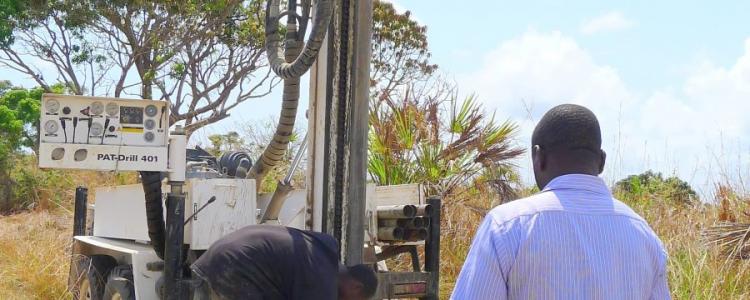
Since ample sunshine is a given in Africa, the solution was quickly found: a solar-powered water supply for the garden was needed. The situation was quickly calculated; an amortization of the necessary investment within one and a half to two years seemed realistic. And so, in March 2017, before the start of the main rainy season (which lasts from April to early May), the initial preparations were made. A larger water tank (10,000 litres) was purchased, a small 1.5-metre-high water tower was built, and a corresponding well (30 metres deep) was drilled. A photovoltaic solar system was then to power a DC solar pump and ensure that the water tank was filled daily – practically free of charge. An irrigation system would then be connected to the tank. Although the solar pump would only operate in sunshine, during cloudy skies or the rainy season, the plants in the garden would hardly need watering anyway.
A technician was quickly found – based on a reliable (I emphasize "reliable") recommendation – who was supposed to get the whole project up and running. He gave us an acceptable price for the well and promised to take care of the details of the solar system – which is where our horror story began!
Contrary to the recommendation of the specialist from the photovoltaic business, our "technician" claimed he needed two additional solar panels. These were quickly acquired – by then the rainy season had ended. However, the attempt to operate the solar pump was not yet successful. The problem, according to the "technician," was two missing batteries to ensure the increased energy demand in the first seconds of the pump's startup (this is a real challenge for any battery when starting petrol engines – but not for electric motors, as we have since learned).
So enough batteries were provided. Still, the pump didn't work. Several weeks had passed by then, as our "technician's" punctuality left much to be desired; he seemed to be a very busy man. Finally, he had found time for us again and stated that a solar controller was needed. We invested another approximately 80 euros and – lo and behold – the pump ran (finally)! We were delighted with 10,000 litres of water daily, as it was already late June, and the dry season had begun.
However, it only took three or four days before our gardener came to me excitedly, reporting that the pump no longer worked. By then somewhat weary of our "technician," I engaged a new specialist (an electrician by profession), who also knows a bit about plumbing.
The pump was pulled out of the well for inspection. It was immediately apparent to the naked eye that it was extremely fouled. The problem, I was told, was that the pump was operated on the muddy bottom of the well and not, as is usual, two or three metres above it. It was – our original technician had to answer for this again – repaired by his son and this time lowered to a height of 2 metres above the muddy bottom. And behold, the water gushed again – surprise: for a full two days! For another repair of the fouled pump, however, spare parts were missing this time, which had to be procured from abroad – and which have not yet arrived to this day (we are in November). So I decided to purchase a second solar pump, as we would inevitably need to set up a second solar irrigation system on another plot in the foreseeable future. The first pump could be used for that – once it is repaired. Furthermore, the garden simply couldn't wait for the pump's repair. This would simply take too long (which eventually proved true) and cost unnecessary petrol and countless hours of work.
Since I no longer wanted to take any risks, I asked a new well-driller to thoroughly clean the well hole again before installing the new pump. I also wanted to ensure that we positioned the pump far enough away from any potentially muddy bottom of the well. We tested the operation for several hours at a depth of 25 metres – thus 5 metres above the 30-metre-deep well. The pump did not run dry; there was enough water present at the 25-metre depth. After the successful test, the pump was permanently installed. By then it was already September – the garden and the gardeners rejoiced at the abundant water available. We almost had to explain to them that plants can also be "drowned".
All seemed well – until last week, the horrific report came that the pump occasionally failed. Now, this could certainly also be due to the rainfall (and lack of sunshine hours) typical of the short rainy season in November. Or perhaps the batteries – which seemed rather unlikely to me. Or was it the solar controller that simply had glitches? Or had the well really run dry – despite the short rainy season? That was rather improbable. Again, the pump was pulled out of the well hole – and behold, it was completely fouled again.
To literally get to the bottom of the problem, it would now have been necessary to lower a small camera into the well shaft. Finding such a device in Africa is certainly not easy and expensive. And the effort would not solve the problem that the well constantly silts up.
Now we remembered that when the pump was being pulled out, it had encountered resistance at a certain point, which was difficult to overcome – by carefully shaking the rope to which the pump was attached back and forth. Just as if it were getting stuck on a protruding PVC pipe.
After consulting with two other well drillers, we came to the logical conclusion that the well, below a certain depth (probably where the resistance occurred when pulling out the pump), no longer has a PVC casing. The well driller must therefore have saved on material. This allows all mud and clay to seep unhindered into the well hole. The bad news: solving this problem in an existing well is not possible.
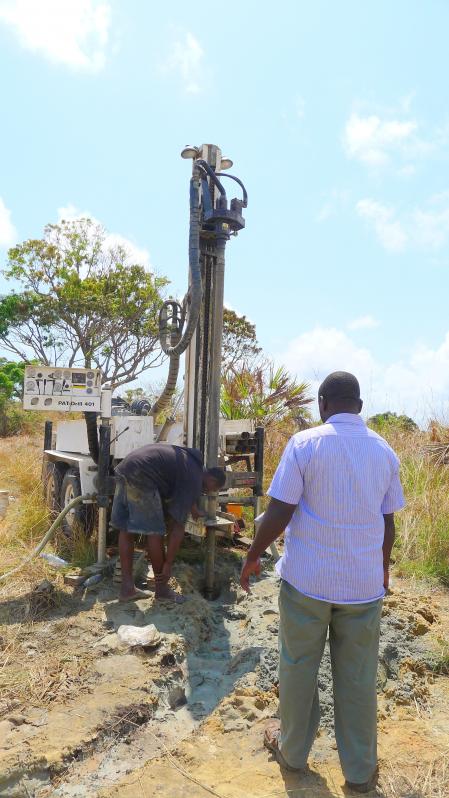
To operate the system again, it would now be necessary to drill a new well hole. Recourse liability to the well driller – as is customary in Europe – does not exist in Tanzania. And even if one wins a lawsuit, the prospect of financial compensation is extremely low. In a country where almost everything is paid in cash and even many medium-sized entrepreneurs do not have bank accounts, there is no realistic hope of recourse. As soon as one has paid someone for their services, the money is usually already spent or distributed to employees, family members, or friends. Saving is a foreign concept to many. Everything is paid in cash, yet practically no one has money.
We wished we hadn't had to make this kind of experience. At the same time, however, we should emphasize that we have been spared many things.
There are a few "rules of the game" we have adopted:
- Generally, make no upfront payments – even with people with whom one has had good experiences in the past.
- This means always owing an amount until absolute completion; then there is great interest in resuming or completing the work on time.
- As tragicomic as it sounds, don't be swayed by the phrase "I have nothing left to eat."
- Only contract craftsmen on the recommendation of trustworthy people; but even that is no guarantee.
- To avoid typical additional demands, describe services precisely. Even terms that are absolutely clear to us are often interpreted completely differently.
- When in doubt, always get a second or third opinion.
- Always maintain a healthy skepticism – according to the motto: Absolutely everyone wants to rip you off (bitter, but true).
- A job successfully completed by a craftsman the first time, under exactly the same circumstances, can look completely different the second time – repeated checking is always better than trusting once.
Craftsmen are often not interested in continuous business and loyal customers. They prefer to have a few more euros in their pocket today than a secure and good income in the coming months. This way of thinking is foreign to us, and it is not easy to get used to these completely different values.
Development work in a culture so different from ours is not easy. We are grateful that we can still smile about most of the problems and that we have been spared greater harm so far. We see this as "God's blessing" and "His guidance."
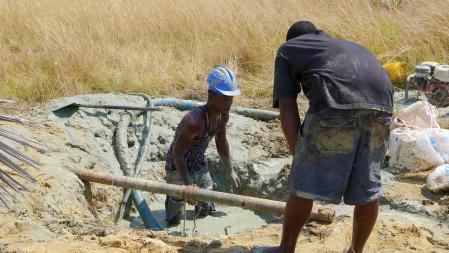
But our story is not yet over. Since the garden has now reached a size where it can survive only a few days without water during the dry season, we decided to tackle the problem immediately. Three well drillers gave us a quote, one of them got the contract, and we assigned a person to ensure that the work for drilling the new well was carried out carefully. I verified the quality of the materials used and was personally present during the most important construction phases. After three days, we were able to lower the "supposedly" repaired solar pump into the new well shaft. Unfortunately, the pump did not work again, and at the same time, we had to realize that the solar converter also failed. The purchase of a replacement pump was unavoidable, and since today, Friday, November 17, the garden's water supply has been working as it should have been since the end of April. We had learned a lot in the last few weeks and can now probably call ourselves well specialists. So we learned something. One simply has to see things in a positive light.
Yours

Thomas Küsel
Vice Chair
Dunia ya Heri
Yours
Judith Klier
Chair
Dunia ya Heri
Donations
To help as many children as possible, we rely on donations. Thank you for your help.