
Newsletter November 2023
Dear Friends,
We want to dedicate this newsletter especially to our children. They continue to bring us much joy, although occasionally a few worries come with it, true to the saying: "Little children, little worries; big children, big worries." Raising so many children responsibly is certainly not easy. Nevertheless, the positive aspects of our daily work always outweigh the challenges. We won't be talking about the worries today.
Our Children
We are now responsible for 31 children. Since our last newsletter, one child has been adopted. The age range is from one to eleven years old. As often mentioned before, our home will be designed for about 50 to 60 children, and we will care for them up to the age of 18. In total, 11 of our children attend our English-speaking primary school.
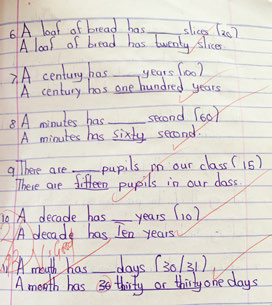
Our schoolchildren can already hold a decent conversation in English, which is rather uncommon in Tanzania. Even our youngest preschoolers understand some English.
Pocket Money
Mom and Dad
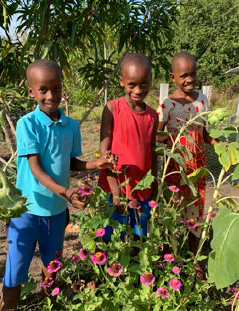
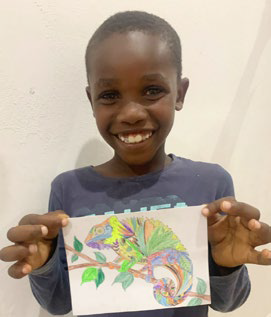
Since August, we have started giving our schoolchildren a small monthly allowance, equivalent to 1.50 Euros. For a small amount, they can buy things like an extra dress, shoes, colored pencils, shovels for their gardening (which we'll get to later), a new ruler for school, or other small items. The pocket money primarily serves to teach the children early on how to handle money responsibly, to appreciate the things they own, and to take responsibility for their possessions.
It is a custom in many churches to give God a tenth of one's income. God has placed a special blessing on this practice and promises that we will not suffer loss through it:
"Bring the whole tithe into the storehouse, that there may be food in my house. Test me in this," says the Lord Almighty, "and see if I will not throw open the floodgates of heaven and pour out so much blessing that there will not be room enough to store it." (Malachi 3:10). So that our children don't just think of themselves, but are willing to give a part of what they receive, we have begun to teach them the principle of tithing.
One of our children came to ask us if they should cut up a banknote (worth 2,000 TSH = less than 1 Euro) to give a small part of it as a tithe. Of course, we were happy to change the banknote into coins.
Another child wanted to support a church project and asked us if we could buy a small, wild mango plant it had found. We agreed, after which it ran straight to the pastor and handed him the money. One of the children asked if they could give some of their pocket money to the younger children – which we, of course, happily affirmed. In the first month after receiving their pocket money, one of the children wanted to buy our binoculars. Since we had no intention of selling the binoculars, I named a price so high that it would be impossible to buy. I asked for one hundred thousand Tanzanian shillings (100,000 TSH = approx. 40 Euros). Promptly, Amalo* told me that he already had the money for it. Of course, I was very surprised by his answer until he assured me again that he possessed one hundred and one thousand shillings (i.e., 1,100 TSH).
Vegetarian Diet
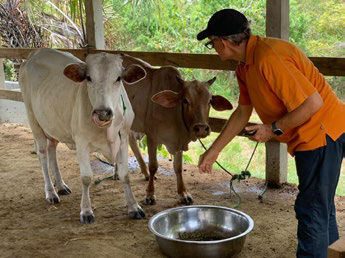
Our children are on a vegetarian diet for health reasons. When they learned that some people believe one must eat meat, they said: "How can you eat animals? That's terrible, we love animals so much." They then came up with some very creative ideas:
- We'll just drop the meat on the floor, then you can't eat it anymore.
- We'll go to the toilet and spit it out again.
- We'll put on pants with the biggest pockets, put it
- in our pocket, and then give it to the cats.
- We'll sprinkle so much salt on it that it becomes inedible.
- Also, we absolutely must pray that the other children in our school don't eat meat.
Gardening
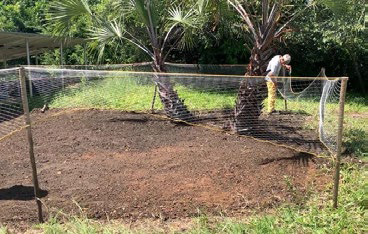
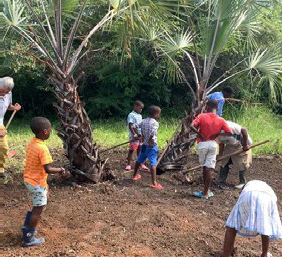
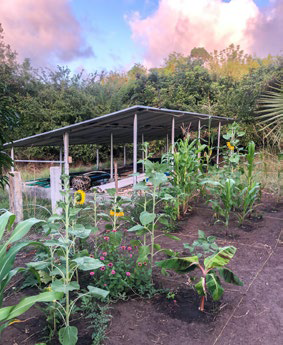
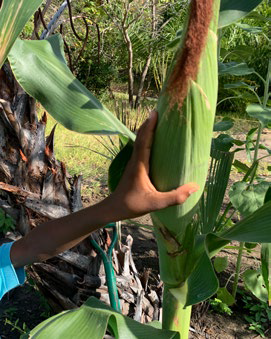
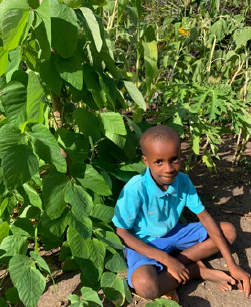
Our schoolchildren have often helped in the garden. They loved their small tasks and asked us for their own plot of land. So, one Sunday, together with the children, we started digging up a piece of garden directly in front of their home, building a fence against the greedy geese and chickens, and allocating each child a plot of about four square meters. Then they received seeds and plants: sunflowers, tomatoes, beans, banana trees, fast-growing papaya trees, corn, etc. Their task was to take care of their garden themselves by regularly watering it morning and evening and making sure no pests took hold. We help them with pests by treating the plants with a little diluted neem oil (a completely natural pesticide).
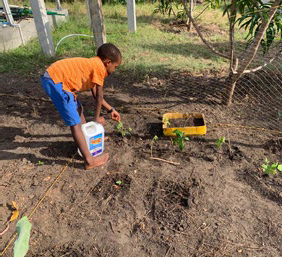
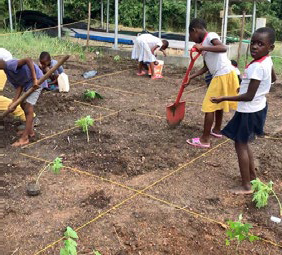
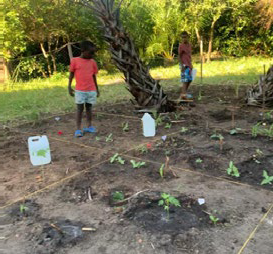
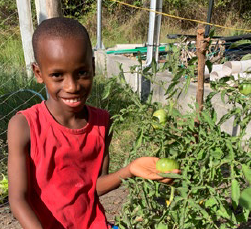
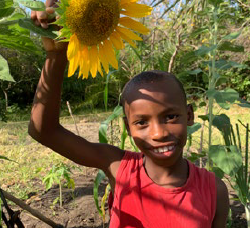
After a few weeks of diligent watering, the first successes are already visible. The sunflowers are blooming, and the first tomatoes are slowly ripening.
The children can decide for themselves whether they want to give their produce to the kitchen or enjoy it themselves. Two particularly entrepreneurial children have already asked us for a larger garden plot so they can plant even more papaya trees. They want to supplement their pocket money and then sell their papayas to the kitchen. Another child has decided to give the produce to poor families in the village.
Piano, Flute, and Sewing Lessons
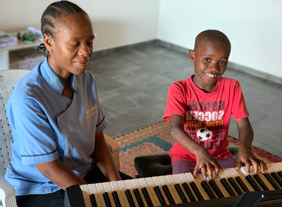
We recently acquired a Yamaha keyboard. One of our caregivers is a piano teacher, which gives some children the opportunity to take regular piano lessons. The beginning isn't entirely easy, but they are definitely making progress.
Two of our boys wanted to own their own recorders so they could practice regularly. We were happy to "sell" them the instruments for a small contribution from their pocket money.
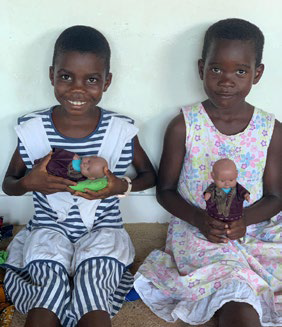
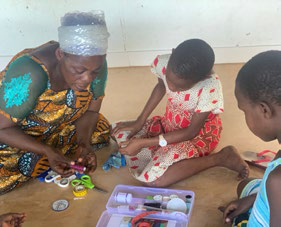
Our older girls recently started taking sewing lessons. The village seamstress was willing to teach them. As a result, the first doll clothes and skirts have already been completed. They really enjoy sewing. Next, we will teach them how to use a mechanical sewing machine.
Home Visits for the Sick
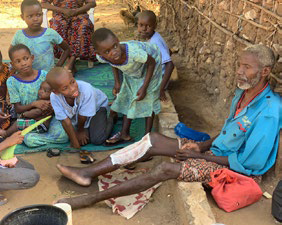
Every Saturday afternoon, we visit needy families in the area. Last Saturday (Sabbath afternoon), we visited the neighbor of one of our caregivers. A few weeks ago, he became unconscious and, in the process, his right leg fell into the open fire of his cooking stove. His lower leg had a large burn wound. A few days before our visit, he was discharged from the hospital because the doctors said there was nothing more they could do for him. The leg looked dreadful. The wound was open to the bone and festering. Our children were very moved by this sight. We treated the leg with antibacterial cream and applied a sterile dressing. Our children pray for the sick person and accompany us daily to see how the patient is doing. Even after a short time, we can already see progress. We continue to hope and pray that the wound heals well.
A week earlier, we visited the family of one of their school friends with the children. The father was born without legs, and the boy's younger sister is also severely disabled. The mother has her hands full caring for her loved ones. The boy is allowed to attend our primary school free of charge due to the difficult family circumstances.
Through visits to needy families, the children learn the practical application of Christian charity. Although they are orphans, they are significantly better off compared to many families in the village.
Why Jesus Died
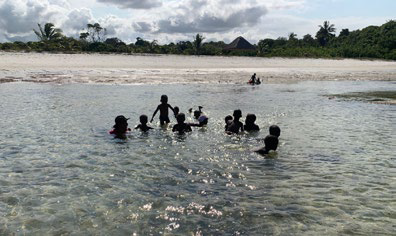
As mentioned, our children are raised according to Christian principles of charity and care for others. This includes regular morning and evening devotions. They particularly enjoy singing songs. They have now memorized over 30 songs with more than one verse. Most of the time, after devotion, we review the most important part of the topic by asking them some questions. To the question of why Christ died for us, the astonishing answer came: "So that people can communicate with their wives again." There was certainly a little misunderstanding there.
Day and Night
To deepen their German language skills, we often show the children selected, easy-to-understand YouTube videos about nature and science. For example, we recently watched a "Sendung mit der Maus" (Mouse Show) about our solar system. They were supposed to learn that day and night exist because the Earth rotates on its own axis. To my concluding question about why there is day and night, the insightful answer was: "So that we can sleep at night and work during the day."
Construction Measures
Our underground cellar on the farm is almost completed.
The demolition of the walls, the solar field, and the remaining roof of our school and church, which were destroyed by a fire in February, has been completed. We will soon begin rebuilding the walls.
The foundation for the new refectory, along with the sewage pipes and appropriate septic tanks, has been laid. Next, the floor slab will be poured. Afterwards, the shell construction will continue. The most difficult part will be the roof structure.
We are currently receiving active support from German specialists for the installation of a fire extinguishing system.
Miscellaneous
In the coming weeks, our home director, Jackline John, will fly to Europe to receive a new free leg prosthesis – we already reported on this in the last newsletter. Obtaining the visa for her was not entirely easy. Our German ambassador thankfully supported us.
We would like to thank you again for your continued help. A special thanks goes to those who donated for the reconstruction of the community/school.
Without you, it is not possible to provide our children with a hopeful future.
Thank you very much!
With kind regards and blessings
Yours

Thomas Küsel
Vice Chair
Dunia ya Heri
Yours

Judith Klier
Chair
Dunia ya Heri
Donations
To help as many children as possible, we rely on donations. Thank you for your help.