
Newsletter September 2017
Dear Friends,
This summer was full of events for Dunia ya Heri. The official inauguration ceremony on June 11th was a particularly significant event, about which Judith Klier, the association's chairwoman, reports the following:
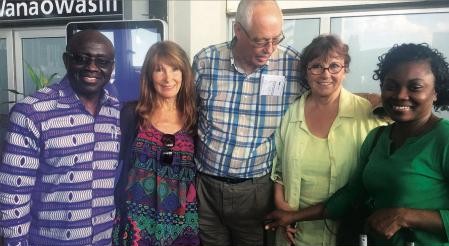
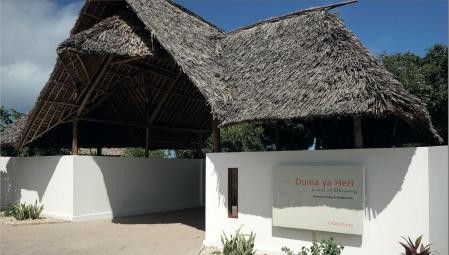
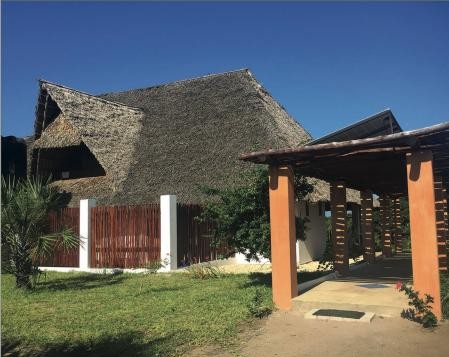
“The main reason for my trip to Tanzania in June 2017 was the ceremonial inauguration and official opening of Dunia ya Heri, our African orphanage. Christel and Gerhard Padderatz accompanied me, representing the German association. Of course, we were particularly excited to see our new children, who had since been admitted – and to what extent the buildings had progressed. Even the entrance, with its gleaming white walls and typical African roof construction, the large Dunia ya Heri nameplate, and the solid gate made of reddish hardwood, made a promising first impression on us. After thorough questioning by the security guard, one is admitted, and the view opens up, past a huge mango tree, to the now completed first home building with its imposing Makuti roof, artfully woven from dried fronds of the fan palm (also see the newly uploaded drone footage on our website).
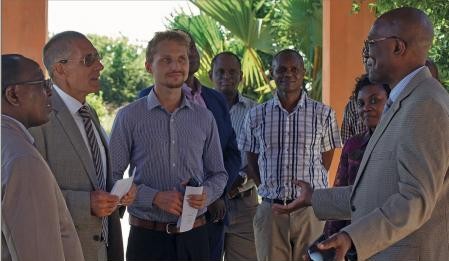
Sunday, June 11th, was the grand opening day. Thomas Küsel had limited the number of invited guests to about 70 to avoid having to rent a marquee. 70 people could easily be accommodated in the sun-protected open entrance and side area of the first children's home. The guest of honor and main speaker at the ceremony was Dr. Mpoki, State Secretary of the Ministry of Health. He was accompanied by two of his department heads, several experts (including the education advisor of the British Embassy), as well as political leaders from the village and district. Reporters from two television stations and a radio station were also present. Dr. Mpoki gave a lively and committed speech, framed by musical contributions and numerous greetings. Among other things, he addressed local politicians directly and assigned them co-responsibility for our project.
A special highlight was a musical piece performed by the children with their mamas – all in Dunia ya Heri T-shirts. Afterwards, Dr. Mpoki officially opened the orphanage by cutting a ribbon to the living quarters of the house and then, together with his entourage, toured the house."
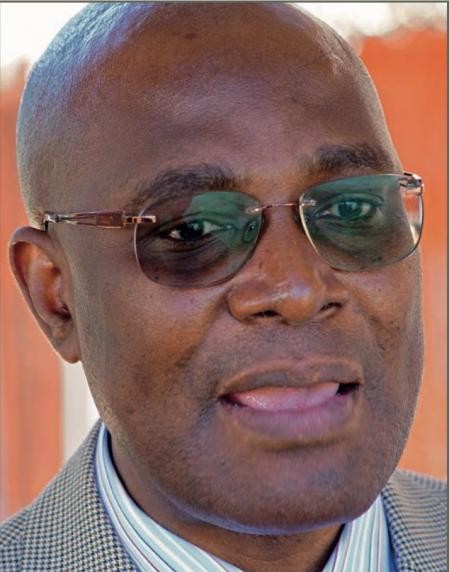
At that time, we had eight children in our care. This number has since increased to 14. With each additional child, the challenges naturally grow. The youngest child – a foundling baby – we received at just three weeks old. The girl is now eight weeks old and is lovingly "nursed" by one of our employees, who herself had a child in January. The baby was abandoned by its parents in Dar es Salaam. Most of our children are between one and a half and two and a half years old. Since the children still need regular diaper changes, our work is very demanding. A lot of time is also spent washing clothes and cloth diapers. We don't use disposable diapers, as that would be too expensive for us and would also complicate disposal. There is no garbage collection as we are used to. We separate organic waste, which is used for composting in the garden; combustible waste (paper, cardboard, wood, etc.), which we burn ourselves; and glass and plastic, which we dispose of every few weeks at a landfill 10 kilometers away. We have three children between the ages of three and five. They bring us a great deal of joy, as they already give back some of the affection we give them. Some of them are even concerned about the well-being of the other children and like to share attention and toys with the younger ones. We see progress in the development of their personalities almost weekly.
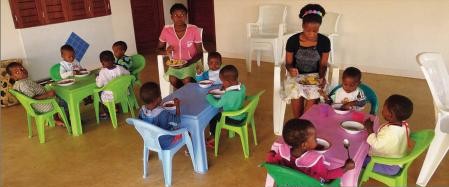
What does our daily routine at Dunia ya Heri look like? The children wake up relatively early, are washed and dressed, so they can have breakfast on the terrace at 6:30 AM. Then there's a wholesome porridge – along with fresh fruit. At 7:00 AM, there's devotion and communal singing. After that, "the serious business of life" begins, so to speak. The older children are allowed to help with the dishes. They wash their own bowls that they used for breakfast – under supervision, of course. Most of the time, we have to wash them again properly afterwards. But they learn to take responsibility this way. And they visibly enjoy it.
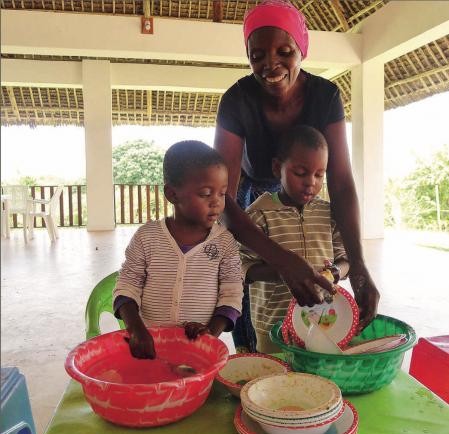
Then the chickens are fed. Each child receives a small bucket with some chicken feed or food scraps, and in a small procession, they head towards the chicken coop, located about 70 meters away. There, they can also check on the chicks and see how many eggs have been laid. Afterwards, some flowers at the entrance of the home are watered. Then, the children help at the washing station to wash at least one of their own clothes. Here too, one or two garments will certainly need to be rewashed. Then the group of children is divided into two. The older children go to "school." They are taught counting or simple reading, or they can practice the recorder or learn some English vocabulary, or draw with crayons. The very little ones are allowed to play, usually with one of the mamas, sitting on a blanket on the terrace.
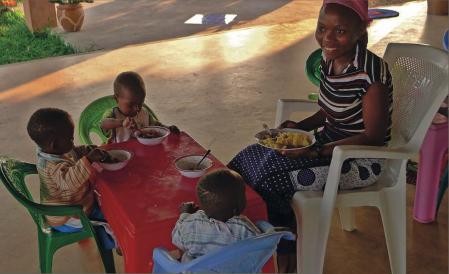
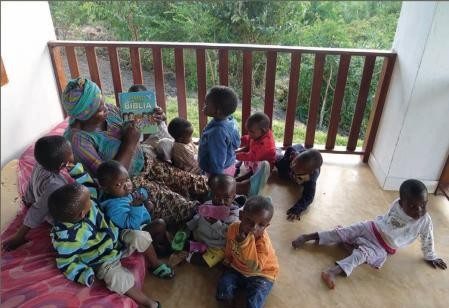
Lunch is just before 12:00 PM, after which most children take their afternoon nap. After the rest period, it's time for a walk on the grounds, sometimes towards the beach or into the organic garden, where the children can tend their own plot. Of course, there's also another chance to play in the afternoon. The Bobby-Car is particularly popular, often used by two children. One pushes, the other gets to steer. Dinner is served at 5:30 PM. This is followed by an evening devotion with songs. After washing, the children are in bed by approximately 7:00 PM. Of course, one or two children – especially our youngest – also need care during the night.
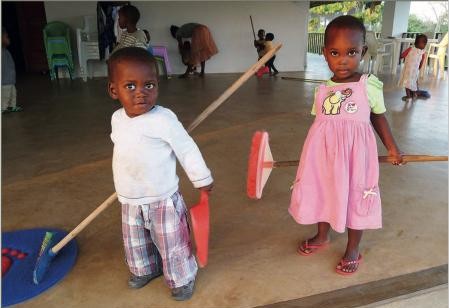
As rosy as the daily routine may seem, there are also some challenges: These include the topic of "hygiene," but also general cleanliness, for example, regarding how to deal with simple things like avoiding contagion from colds or diarrheal diseases, children blowing their noses with paper tissues, wearing shoes, washing hands after using the toilet, disinfecting cloth diapers, etc. The list could almost be continued indefinitely. Of course, no one can be blamed if these things were never learned, and their learning and observance take some time.
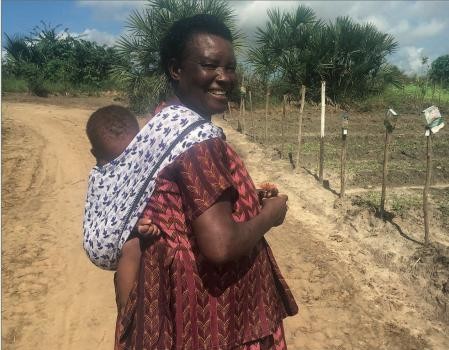
We currently have a total capacity for 20 toddlers and hope to expand this to a total of 35 children within a few months, once the next home building is completed. However, it is important that our care staff develops alongside this expansion. In the coming months, we will only take in additional children on the condition that our staff are well-trained and that the standards we must adhere to, not least because of our state approval, can be met. Therefore, our most important task right now is to train appropriate personnel.
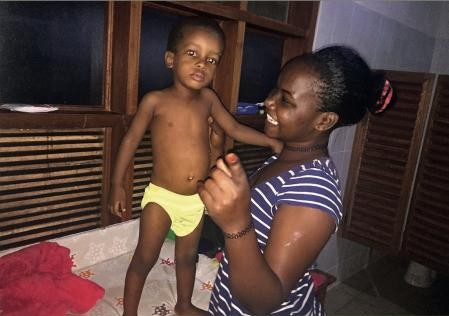
Although personnel costs in Tanzania are a fraction of what is paid in salaries in Europe (the salary for an unskilled worker in Tanzania is about 100 euros per month), we must account for almost half a staff position for the care of each child (including vacation, holidays, illnesses, regular days off, etc.) – which adds up to a considerable amount. This is because we take in toddlers, who require an extremely high level of care, and we are one of the few orphanages in Dar es Salaam that offers this possibility. Most homes only accept orphans aged about 4 or 5 and older.
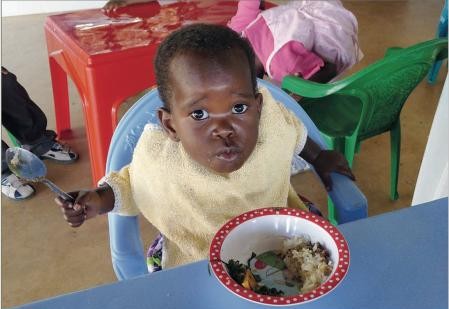
Besides the caregivers for our children (affectionately called "mamas"), we need assistants for laundry, cleaning, and cooking, as well as security personnel for the property and gardeners for the organic garden and property maintenance. Furthermore, the state requires us to employ a social worker and a nurse and to keep a part-time doctor under contract to examine the children at regular intervals. In total, the current staff – excluding construction workers – consists of 16 employees. The running costs for personnel, food, and other expenses amount to approximately 4,500 euros per month (which, by European standards, would be equivalent to employing only two people). The future expenditure for the care of 20 additional children (making a total of 35) would only represent an insignificant cost increase of about 1,200 euros per month, as mainly the care staff would need to be increased. Although we have been able to pay salaries at the end of each month so far – which seems like a small miracle to us – we cannot yet cover the running costs solely through regular monthly donations. We hope and pray that this will soon be the case. In addition to all one-time contributions to the Dunia ya Heri account, we welcome any standing order that we can regularly count on, even if it only covers a portion of a salary. Your monthly contribution helps us cover the expenses that increase with the growing number of children.
At the same time, we would like to thank all those whose willingness to sacrifice made it possible for our Dunia ya Heri project to come into being and provide a home for the first 14 children.
A few more words about our construction matters: A proper stable for about 50 free-range chickens has finally been built. Previously, they were only housed in a makeshift structure. Concurrently, a solar-powered well system for automatic irrigation of the vegetable garden, especially during the long dry season, has been put into operation. The 1,000 mango trees and 250 coconut palms planted before the rainy season in April are thriving. The ring beam, the floor slab, and the preliminary electrical installation of the next
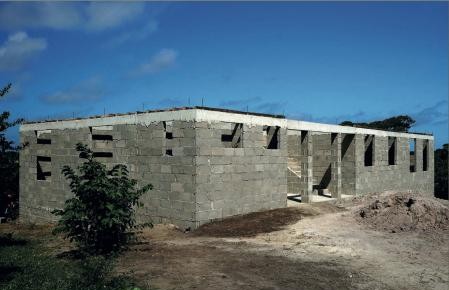
residential building for 15 more children have now been completed. This building will also be ready for occupancy by mid-next year. We still hope that our water tower with 40,000 liters of service water, a photovoltaic system, and two solar pumps can be built this year. ADRA Luxembourg (an Adventist Development and Relief Agency) has agreed to support us in this measure. Although most children in Africa grow up without a playground, the construction of a playground is necessary as a prerequisite for the approval of our orphanage. Unfortunately, a good friend, a carpenter from Germany, who wanted to help us build the playground by the end of the year, was incapacitated due to an industrial accident. As you can see, there is still a lot to do with the construction projects. The planned maximum capacity of 60 children is still a long way off.
There is another way to support us – free of charge, so to speak:
The online retailer Amazon now also offers customers in Germany the opportunity to support social institutions with every purchase – without extra effort. For every transaction, Amazon transfers 0.5 percent of the purchase amount to an institution that the customer chooses. Only non-profit organizations that have gone through an elaborate registration process benefit. "Dunia ya Heri" has recently been registered as an "Amazon Smile" organization under the motto "Shop and Do Good". We ask all friends and supporters to consider "Dunia ya Heri" as an organization when shopping on Amazon. Registration is possible at www.smile.amazon.de and by explicitly entering our name "Dunia ya Heri" (Caution: Without explicit entry of our organization, a randomly selected company chosen by Amazon will be supported).
Yours

Thomas Küsel
Vice Chair
Dunia ya Heri
Yours

Judith Klier
Chair
Dunia ya Heri
Donations
To help as many children as possible, we rely on donations. Thank you for your help.